Content
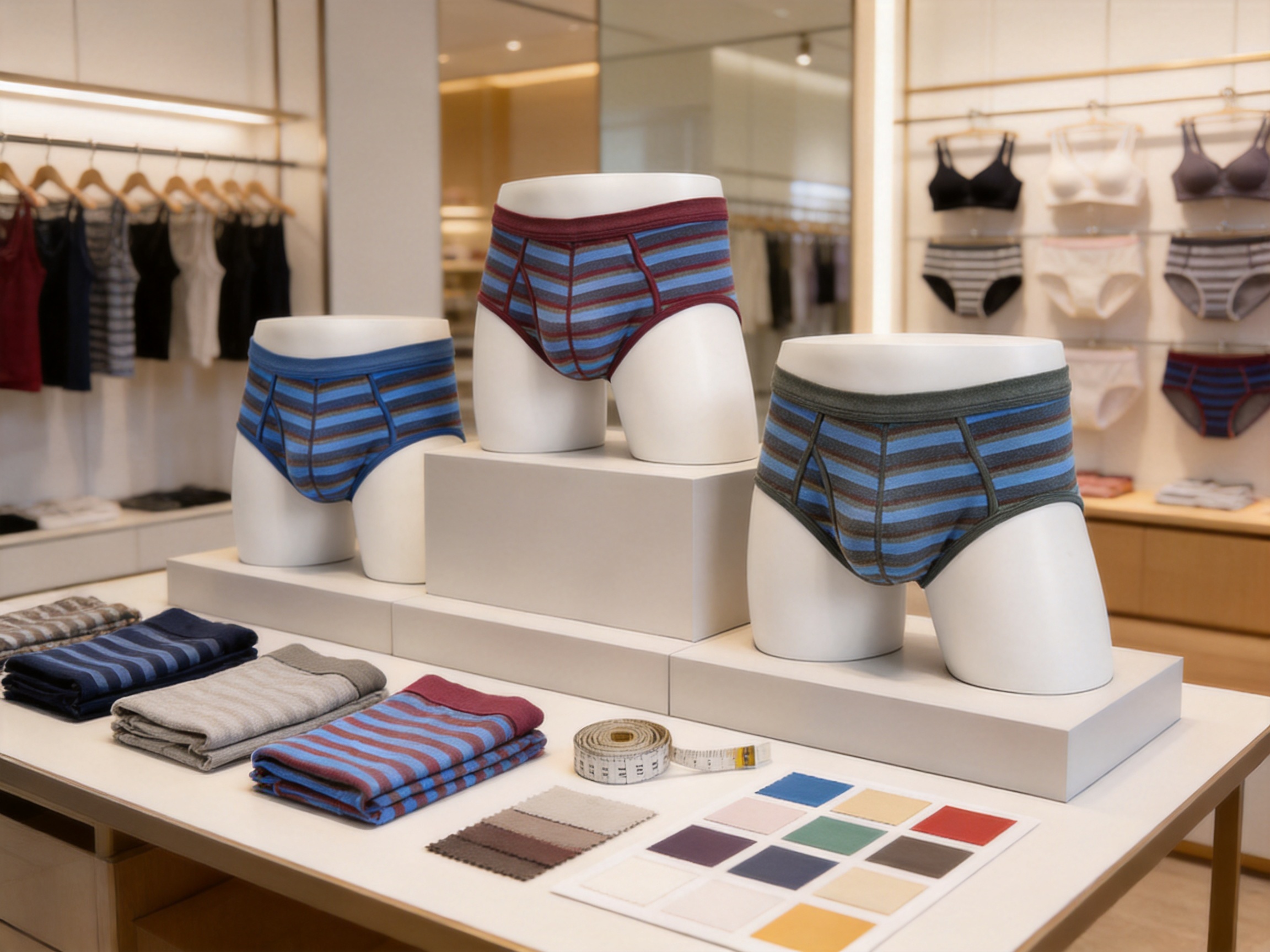
Quick Answer: Striped Split-Front Bamboo Viscose Briefs are designed for buyers seeking a breathable, moisture-managing men’s brief with a distinctive open-front construction, soft hand feel, and responsible fiber story. Made with 40s bamboo viscose and detailed using specialized multi-needle stitching, the brief combines comfort, visual contrast, durability, and a fashion-forward silhouette. For retailers, private labels, and underwear distributors, the product is especially suitable for collections positioned around premium breathable underwear, organic bamboo underwear, sustainable materials, and customized OEM/ODM production.
The strongest advantages are practical as well as visual: bamboo viscose offers a smooth next-to-skin sensation, the open split-front construction promotes airflow, contrasting waist fabric adds a clear design feature, and reinforced stitching supports repeated wear. The manufacturer’s experience in underwear development, fabric sourcing, quality control, and customized production also gives brands a reliable foundation for launching or expanding a bamboo underwear range.
This guide examines the product’s construction, fabric, comfort performance, manufacturing details, customization potential, quality considerations, and commercial applications. It is written for underwear brands, sourcing managers, apparel importers, e-commerce sellers, and retailers comparing premium breathable underwear suppliers.
Consumers are paying closer attention to the experience of wearing underwear throughout the day. They want softness without excessive heat, secure construction without restrictive pressure, and attractive details that make basic garments feel more considered. At the same time, buyers increasingly ask where fibers come from, how products are dyed, whether production partners can support responsible sourcing, and how consistently a style can be reproduced.
Striped Split-Front Bamboo Viscose Briefs answer these needs through a combination of material choice and construction. The product is not positioned as an ordinary basic brief. Its striped body, contrasting waistband, and split-front treatment create a recognizable appearance, while the bamboo viscose fabric provides a soft and lightweight foundation for daily wear.
The design also fits several important retail categories:
Premium breathable underwear for consumers who dislike heavy or poorly ventilated fabrics.
Organic bamboo underwear collections built around natural-fiber stories and softer hand feel.
Fashion underwear ranges that use contrast panels, stripes, and distinctive front construction.
Private-label underwear programs requiring repeatable manufacturing and flexible product development.
Giftable or lifestyle underwear lines where packaging, color customization, and visual identity matter.
A successful product must do more than look attractive in a catalog. It must maintain its shape, feel comfortable against the skin, resist seam failure, and arrive with consistent coloration and sizing. These points make the manufacturing process as important as the design concept.
| Item | Product Detail |
|---|---|
| Product name | Striped Split-Front Bamboo Viscose Briefs |
| Product code | THDY-017 |
| Category | Men’s briefs |
| Primary material | 40s bamboo viscose |
| Dyeing approach | Dope-dying bamboo viscose yarn |
| Main design elements | Striped body, split-front opening, contrasting waistband |
| Front construction | Four-needle, six-line stitching inside and outside at the front center |
| Waistband construction | Three-needle, four-line stitching at the upper waist |
| Best positioning | Premium breathable underwear and sustainable-fiber underwear collections |
The combination of a specific yarn count, dope-dying method, and reinforced stitching gives product developers useful points for specification sheets. A brand can communicate tangible construction details instead of relying only on broad terms such as “soft” or “eco-friendly.”
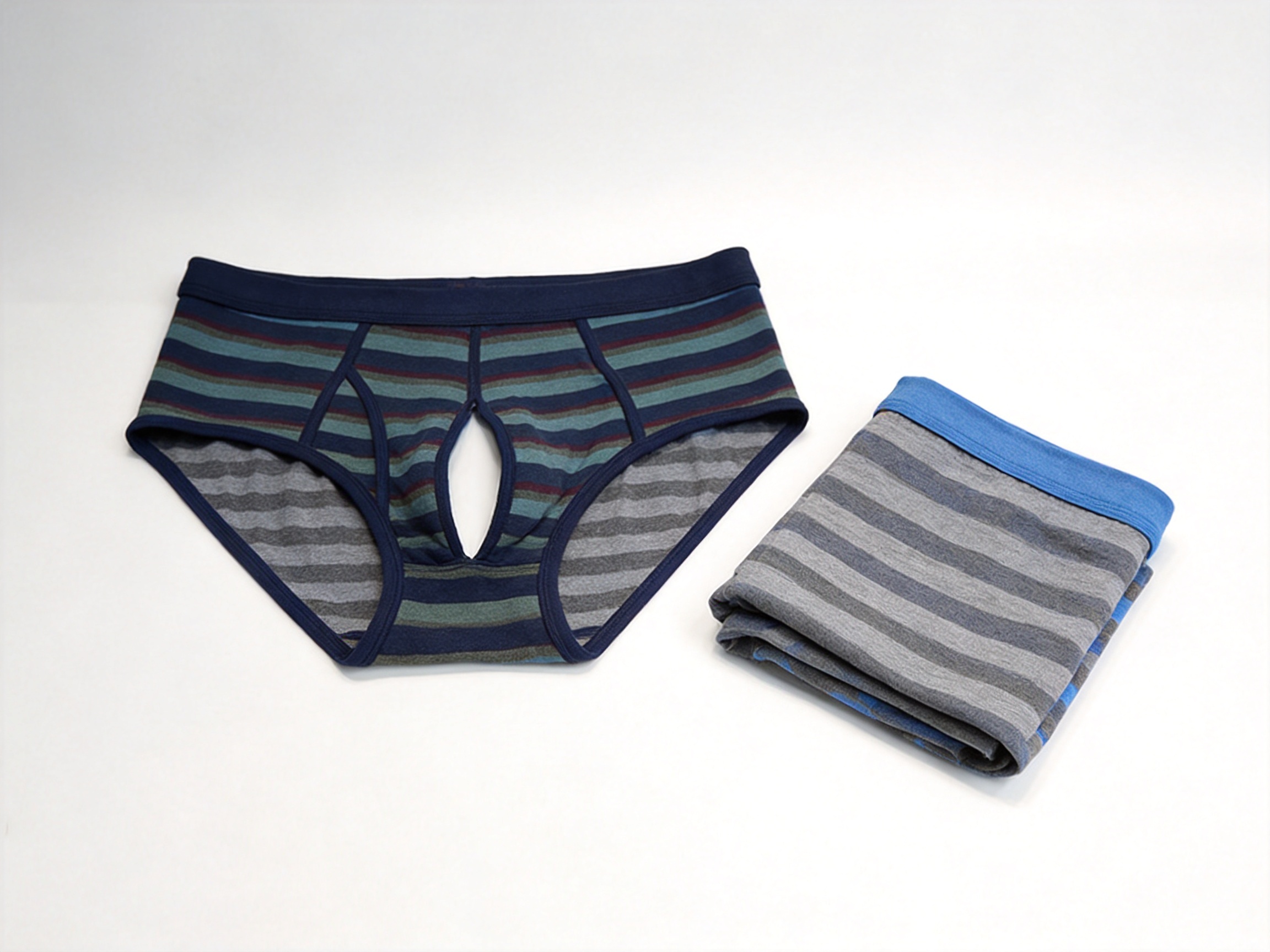
The open split-front design separates this brief from conventional closed-front underwear. It creates a more relaxed and visually distinctive front profile while supporting airflow in an area where heat and moisture can accumulate. The construction is intended to blend ease of movement with a more expressive appearance, making it suitable for buyers who want underwear to feel personal rather than purely utilitarian.
For retailers, a distinctive silhouette can improve product separation on a crowded product page. Standard briefs often compete through color and price alone. A split-front feature gives the style a recognizable point of difference that can be explained in a short product description and shown clearly in photography.
For wearers, the practical question is whether the opening is finished cleanly and supported by stable stitching. The four-needle, six-line treatment at the front center addresses this requirement by adding visible reinforcement to a high-attention construction area. The stitching also creates a more deliberate appearance than a simple unfinished opening.
Stripes add rhythm to the body of the brief and make the product easier to merchandise as part of a coordinated collection. Depending on the color combination, the same base design can communicate sport, minimalism, retro styling, or modern luxury. A manufacturer with suitable dyeing and fabric-development capabilities can adapt the palette for different markets while maintaining the product’s recognizable structure.
Stripe alignment is an important quality checkpoint. The pattern should be reviewed at the side seams, front panels, and waistband junctions. Small variations can occur in knitted or stretch fabrics, but consistent cutting, panel matching, and sewing control help maintain a polished final appearance.
The waistband uses contrasting-color fabric rather than blending completely into the body. This gives the brief a clear visual border and provides an opportunity for private-label branding. Depending on the approved specification, the waistband can be coordinated with the stripe colors, matched to packaging, or used as a stronger accent.
A contrasting waistband also supports easy size and color identification during retail handling. Brands can create a family of products using the same body construction while changing the waistband and stripe combinations. This approach can make a collection look intentionally designed rather than assembled from unrelated stock items.
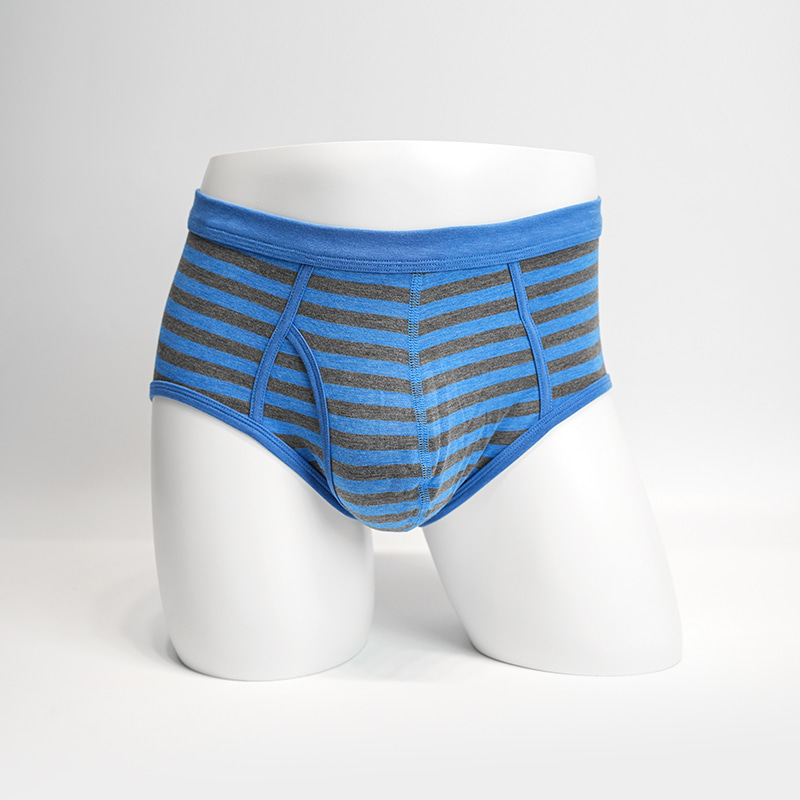
Striped Split-Front Bamboo Viscose Briefs
Bamboo viscose is valued in underwear because it can provide a smooth, soft textile surface when properly processed and knitted. The fiber is commonly selected for garments worn directly against the skin, where roughness, bulk, and poor moisture management can quickly affect comfort.
The 40s bamboo viscose specification indicates a relatively fine yarn suitable for lightweight apparel. In a well-constructed brief, the fabric can feel smooth and flexible rather than stiff or heavy. This is useful for daily wear, travel, workwear, and casual clothing because the underwear is less likely to feel bulky under trousers or fitted garments.
Softness is influenced by more than fiber type. Yarn quality, knitting parameters, finishing, dyeing, washing, and fabric weight all affect the final hand feel. A responsible product specification should therefore identify the fiber blend, fabric construction, weight tolerance, finishing requirements, and acceptable hand-feel standard instead of treating “bamboo” as a complete quality description.
Breathability depends on fabric structure, garment fit, body coverage, and the wearer’s environment. Bamboo viscose can be used in lightweight fabric constructions that allow air movement and reduce the dense, closed sensation associated with some heavier underwear materials. The split-front design adds another functional element by reducing obstruction in the front area.
Buyers searching for premium breathable underwear should evaluate the complete garment rather than judging fabric alone. A breathable brief should have suitable fabric weight, effective seam placement, a waistband that does not create excessive pressure, and a cut that permits movement. THDY-017 brings these elements together through lightweight bamboo viscose, an open-front detail, and structured stitching.
Bamboo viscose is frequently selected for its comfortable moisture-handling feel. The fabric may help move moisture away from the immediate skin surface and can dry more comfortably than some dense, low-absorption constructions. Actual performance varies according to fiber blend, fabric finish, knit density, environmental conditions, and laundering.
Product pages should use measured or carefully qualified language. “Moisture-managing,” “lightweight,” and “breathable” are useful descriptions when supported by the construction. Claims such as “keeps the body completely dry” or “prevents all odor” would be too broad without specific test evidence.
Bamboo is a renewable plant resource, but bamboo viscose is produced through a chemical conversion process that turns bamboo-derived cellulose into regenerated fiber. Brands should present the material accurately: it is a bamboo-derived viscose fiber, not an untreated natural bamboo textile. Environmental performance depends on raw-material sourcing, chemical management, energy use, water treatment, manufacturing controls, and certification.
For buyers developing organic bamboo underwear, supply-chain documentation matters. Relevant questions include:
What fiber composition is used in the finished fabric?
What documentation supports the claimed bamboo content?
Which certifications apply to the fiber, fabric, garment, or facility?
How are dyes, wastewater, and restricted substances managed?
Can production batches be traced from fabric receipt through final inspection?
Nantong Tianhong Textile Technology Co., Ltd. identifies sustainable development, environmentally responsible functional fabrics, and traceable supply-chain management as areas of focus. The company also reports experience with standards and programs including FSC, OCS, OEKO-TEX 100, GOTS, WRAP, and BSCI. Buyers should confirm the current scope, validity, certificate holder, and product applicability of any certification before using it in marketing materials.
The product information specifies 40s bamboo viscose dope-dying. Dope-dying, also called solution dyeing, introduces color into the spinning solution before the fiber is formed. Compared with dyeing an already formed textile, this method can reduce certain downstream dyeing requirements and may support improved color consistency when the process is tightly controlled.
For an underwear buyer, the potential advantages include stable color development, a clean appearance, and a process that may reduce water demand compared with some conventional piece-dyeing routes. The precise environmental benefit depends on the supplier’s equipment, process controls, energy source, chemical management, and production conditions.
Color approval remains necessary. A buyer should review lab dips or equivalent color standards, test colorfastness to washing and perspiration, and check shade variation across production lots. Striped underwear is especially dependent on color harmony because multiple tones appear in a small garment.
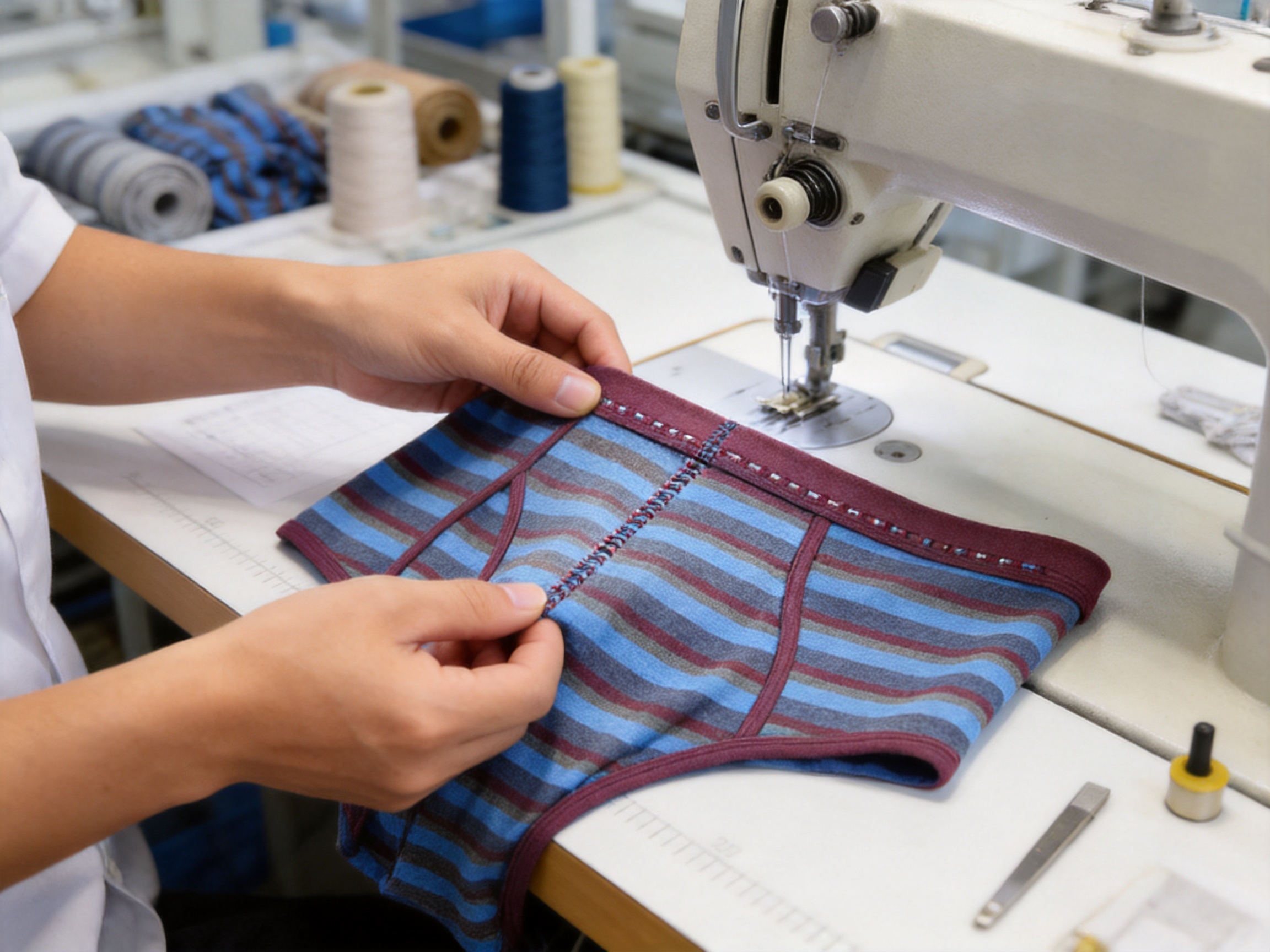
The front center is stitched on both the inside and outside with a four-needle, six-line process. This type of multi-needle construction is relevant for a split-front brief because the opening and adjacent seams need a clean finish, controlled stretch, and resistance to repeated movement.
Reinforced stitching can improve the product in several ways:
Seam stability: Multiple lines distribute tension across the construction rather than placing all stress on one narrow stitch path.
Comfort: A controlled inner finish can reduce loose threads and irregular seam edges that may irritate the skin.
Appearance: Parallel stitching gives the front a precise, engineered look consistent with a premium product.
Durability: Stronger seam construction helps the garment withstand stretching during dressing, sitting, walking, and laundering.
Seam reinforcement does not remove the need for testing. Stitch density, thread selection, needle size, fabric recovery, and operator consistency all affect the result. Production teams should inspect skipped stitches, broken threads, seam grin, puckering, and uneven tension.
The upper waist is stitched with a three-needle, four-line process. The waistband is one of the most important comfort zones in a brief because it must remain secure without creating excessive pressure. It also experiences repeated extension and recovery throughout the day.
The specified construction can provide a neat external finish and help maintain the relationship between the contrasting waistband fabric and the body. The waistband should be checked for even width, consistent elastic tension, clean joins, and secure attachment at the side seams. A visually attractive waistband loses value if it rolls, twists, digs into the skin, or relaxes too quickly after washing.
| Comparison point | Striped Split-Front Bamboo Viscose Briefs | Typical basic brief |
|---|---|---|
| Material story | Bamboo-derived viscose with a premium soft-hand positioning | Often positioned mainly by price or standard fiber content |
| Front design | Split-front construction with reinforced multi-needle stitching | Usually a closed and conventional front |
| Visual differentiation | Stripes and contrasting waistband | May rely primarily on solid colors |
| Breathability positioning | Lightweight bamboo viscose combined with an open-front detail | Varies significantly by fabric and cut |
| Private-label potential | Suitable for color, label, packaging, and specification customization | May offer fewer distinctive development points |
| Retail positioning | Premium, sustainable-fiber, fashion-focused, and comfort-led categories | Basic value or everyday essentials |
The product’s competitive advantage does not depend on a single feature. Bamboo viscose alone is widely available, and striped briefs are not new. The stronger proposition comes from combining a soft regenerated fiber, an unusual split-front profile, contrasting design details, and reinforced construction in one coordinated garment.
This combination gives a brand more ways to communicate value. A product page can discuss comfort, fabric origin, breathability, stitching, visual design, and customization without making unsupported medical or performance claims. For wholesale buyers, it creates a product with a clearer identity than an unbranded commodity brief.
The waistband should sit securely without leaving excessive marks. During fitting approval, assess the garment while standing, sitting, walking, and bending. A waistband that feels comfortable in a static fitting may become restrictive after several hours or during movement.
The split-front design should be evaluated for coverage, support, and movement. The opening needs to remain intentionally positioned without excessive gaping or accidental distortion. Buyers should confirm the approved pattern, seam allowance, opening dimensions, and grading rules across the full size range.
The leg openings should remain flat and comfortable. Too much tension can create pressure, while insufficient recovery may allow the brief to ride up or lose its shape. Stretch and recovery testing, combined with wear trials, can help determine whether the finished garment performs as expected.
Inner seam placement matters in underwear because the garment remains in close contact with sensitive skin. Inspect the front center, side seams, leg openings, and waistband attachment for rough edges, loose threads, bulky intersections, and inconsistent stitch tension.
A manufacturer should provide a measurement chart based on the approved sample and target market. Do not assume that a standard size label has the same body measurements in every country. Brands should define waist measurement, rise, front depth, leg opening, waistband width, and acceptable tolerances before bulk production.
Quality control should begin before cutting. The most efficient programs define measurable standards early and use the same approved reference throughout sampling, production, and final inspection.
Confirm fiber composition and yarn specification against the purchase order.
Check fabric weight, width, stretch, recovery, and surface appearance.
Compare body stripes and waistband colors with approved standards.
Review shade consistency between panels and across production lots.
Test colorfastness to washing, rubbing, perspiration, and water where appropriate.
Inspect the four-needle, six-line front-center stitching for skipped stitches and uneven tension.
Inspect the three-needle, four-line waistband stitching for secure attachment and consistent width.
Check split-front alignment and symmetry.
Verify stripe alignment at key seams.
Remove loose threads and confirm that internal finishes are comfortable.
Measure finished garments against the approved size chart.
Check waist, rise, front opening, leg opening, and total side length.
Compare size grading between adjacent sizes.
Conduct movement and wear trials on representative sizes.
Review shrinkage after the specified laundering procedure.
Confirm fiber labels, care labels, country-of-origin marks, and size information.
Verify packaging quantities and barcode placement.
Check that marketing claims match available documentation.
Review restricted-substance requirements for the destination market.
Keep pre-production, inline, and final-inspection records.
OEM production is useful when a brand already has a defined design, fabric specification, label system, and packaging plan. ODM production is useful when the buyer wants to adapt an existing product concept or develop a new collection with support from the manufacturer’s product-development team.
For this brief, potential customization areas include:
Fabric: Adjust fiber composition, weight, stretch percentage, or surface finish according to the target market and price point.
Color: Develop new stripe combinations, waistband contrasts, seasonal palettes, or coordinated multi-style collections.
Branding: Add woven labels, printed care labels, custom waistband branding, hangtags, stickers, and retail packaging.
Fit: Modify rise, waist position, leg opening, front coverage, and size grading.
Construction: Review seam treatments, stitch color, opening dimensions, and reinforcement specifications.
Commercial presentation: Create packaging and product information aligned with a sustainable underwear or premium comfort collection.
Customization should be managed through a documented approval process. A buyer should approve the fabric, color, artwork, measurements, construction details, labeling, packaging, and pre-production sample before bulk cutting begins. Verbal changes made late in production create avoidable risks in cost, timing, and consistency.
Nantong Tianhong Textile Technology Co., Ltd. was established in 2001 in Nantong, Jiangsu Province, a major textile manufacturing area in China. The company specializes in the research, manufacturing, and sales of underwear products and provides OEM/ODM services for domestic and international labels.
The company’s stated experience includes long-term cooperation with customers in Europe, North America, and China. This international customer base is relevant to buyers who need support with different sizing systems, labeling expectations, product documentation, and delivery requirements.
Its stated strengths include:
Underwear research and product development.
OEM and ODM production for private labels.
Focus on natural-fiber fabrics and environmentally oriented functional materials.
Traceable supply-chain management.
Experience with sustainability and social-compliance standards.
Support for customized underwear collections.
These capabilities are valuable because underwear development requires coordination across fabric selection, pattern engineering, sewing, finishing, quality control, labeling, and packaging. A supplier that can manage these stages as a connected program may reduce communication gaps between separate vendors.
The bamboo-derived fiber story supports collections built around softer materials and more responsible sourcing. Brands should pair the product with accurate information about fiber composition, certification scope, care, and manufacturing. The split-front styling also helps a sustainability-focused label avoid an overly plain product range.
Stripes, contrast color, and the open-front profile provide strong visual material for lookbooks and e-commerce photography. A fashion label can position the brief as a statement style while retaining practical comfort features such as lightweight fabric and structured seams.
Distributors can offer the brief to boutiques, specialty retailers, online stores, and lifestyle merchants that need products with a clear story. Wholesale buyers should request carton details, size ratios, color options, lead times, minimum order quantities, and sample availability before listing the item.
The product offers several content angles for online merchandising: bamboo viscose hand feel, breathable construction, striped styling, contrasting waistband, reinforced front stitching, and private-label potential. Product photography should show the front design clearly, while size information should reduce uncertainty for first-time buyers.
Custom-branded underwear can be considered for premium gift sets, lifestyle campaigns, membership programs, and selected hospitality applications. Packaging and labeling should be adapted to the intended use, and buyers should confirm whether the target market has special requirements for textile composition or product claims.
Define the target position. Decide whether the product will be sold as premium breathable underwear, sustainable bamboo underwear, fashion underwear, or a combination of these categories.
Confirm the technical specification. Record fiber content, yarn count, fabric weight, color standards, measurements, stitch types, waistband construction, labels, and packaging.
Request samples. Review the physical hand feel, fit, stitching, front opening, stripe alignment, and waistband comfort.
Conduct testing. Arrange suitable tests for colorfastness, dimensional stability, stretch recovery, seam strength, fiber composition, and restricted substances.
Approve a pre-production sample. The approved sample should represent the exact bulk-production specification.
Set inspection standards. Define critical, major, and minor defects along with acceptable tolerances.
Confirm production and packaging details. Review quantities, carton marks, shipping documents, labels, and delivery schedule.
Complete final inspection. Inspect finished goods before shipment and retain records for future repeat orders.
This process is useful for both small and large orders. The scale may change, but the need for clear specifications remains the same. A repeat order is most efficient when the first order creates a complete technical reference.
Care instructions should follow verified testing rather than generic assumptions. Bamboo viscose garments are commonly washed according to a gentle textile-care program, but the correct label depends on the finished fabric, elastics, dyes, trims, and construction.
For consumer-facing information, brands may recommend following the sewn-in care label, washing with similar colors, avoiding excessive heat when the fabric specification requires it, and preventing harsh treatment that could affect elastic recovery. Clear care instructions can help preserve softness, color, and fit.
Retailers should avoid presenting the brief as maintenance-free. Every textile product benefits from appropriate washing and drying. A well-designed care label protects both the customer experience and the manufacturer’s product reputation.
The product combines a striped bamboo viscose body, a contrasting waistband, a split-front design, and reinforced multi-needle stitching. Standard briefs may use a closed front and simpler construction, while this style offers a more distinctive silhouette and stronger visual identity.
The lightweight bamboo viscose construction is intended to support a breathable, comfortable wearing experience. Breathability also depends on fabric weight, knit structure, garment fit, climate, and activity level. The split-front detail can further support airflow in the front area.
No. Bamboo viscose is a regenerated cellulose fiber made from bamboo-derived material through a chemical conversion process. Product descriptions should use the accurate term “bamboo viscose” and identify any certified claims according to valid documentation.
It refers to the yarn count specification. In general, a finer yarn count can support a lighter and smoother fabric, although the final result also depends on knitting, finishing, fabric weight, and blend composition.
Dope-dying introduces pigment or color into the spinning solution before the fiber is formed. It can support color consistency and may reduce certain later dyeing requirements. Buyers should still approve colors and test colorfastness for the finished product.
The construction provides multiple lines of reinforcement and a controlled finish around the split-front area. It supports seam stability, appearance, and durability, provided that the stitching is produced with correct tension and quality controls.
It creates a visual contrast with the striped body and gives the product a more designed appearance. For private-label customers, the waistband can also become part of a broader color and branding system.
Yes. Potential customization may include fabric specifications, stripe colors, waistband colors, sizing, labels, packaging, stitch details, and branding. Exact options, minimum order quantities, sampling charges, and lead times should be confirmed with the manufacturer.
Yes. The product can serve as an OEM base style for a defined brand specification or as an ODM starting point for a customized collection. The buyer should approve all technical details before bulk production.
Ask which organization issued the certification, which company or facility holds it, what products and processes it covers, its validity period, and whether the specific fabric or finished garment is included. Never assume that a facility-level certificate automatically applies to every product.
It is suited to consumers who value soft, lightweight, breathable underwear with a distinctive design. Commercially, it fits premium underwear brands, sustainable-fiber collections, fashion underwear labels, wholesalers, and private-label retailers.
Striped Split-Front Bamboo Viscose Briefs offer a balanced proposition for the premium underwear market. The product has a clear design point of difference, a soft bamboo-derived fiber base, a breathable comfort position, and detailed stitching that supports durability and presentation.
Its commercial strength comes from the way these elements work together. The stripe pattern and contrasting waistband make the brief easy to identify. The split-front construction gives it a more expressive profile. The 40s bamboo viscose fabric supports a lightweight and smooth hand feel. Dope-dying provides a defined color-development story, while four-needle and three-needle stitching add technical substance to the product description.
For brands, the next step is not simply to order a sample. It is to establish a complete product specification, test the garment in realistic conditions, confirm the correct documentation, and align the final design with the intended retail market. When those steps are followed, the brief can become a strong addition to a premium breathable underwear collection and a practical platform for OEM/ODM customization.
1. Product specification for Striped Split-Front Bamboo Viscose Briefs, product code THDY-017.
2. Company information supplied for Nantong Tianhong Textile Technology Co., Ltd., including manufacturing history, OEM/ODM capabilities, and supply-chain focus.
3. International Organization for Standardization, guidance and standards related to textile testing, colorfastness, dimensional stability, and fiber analysis.
4. OEKO-TEX Association, general framework for textile safety and restricted-substance assessment.
5. Global Organic Textile Standard, requirements and principles for certified organic textile processing and production.
6. Organic Content Standard, chain-of-custody principles for products containing certified organic material.
7. Forest Stewardship Council, principles for responsible forest-based material sourcing and relevant cellulose-fiber supply chains.
8. International Labour Organization, guidance on decent work, workplace safety, and responsible textile manufacturing.

Copyright © Nantong Tianhong Textile Technology Co., Ltd. All Rights Reserved.
 Room 806, Building D, Jingyang Plaza, Chongchuan District, Nantong City, Jiangsu Province,china


 English
 Español
 русский
 عربى